

Featured Image: tiktok.com/@chaiduran
3 weeks ago, a LinkedIn message showed up in my inbox from a Talent Sourcer at an agency. They were hiring for remote and full-time VAs and they had a clear preference for candidates with a master’s degree.
I wasn’t applying for jobs, but I have an MBA. So, I was curious to see what kind of role this agency was packaging around graduate credentials. I replied to find out.
That single reply turned into one of the most revealing experiences I’ve had as a virtual assistant.
Then Came the Assessment

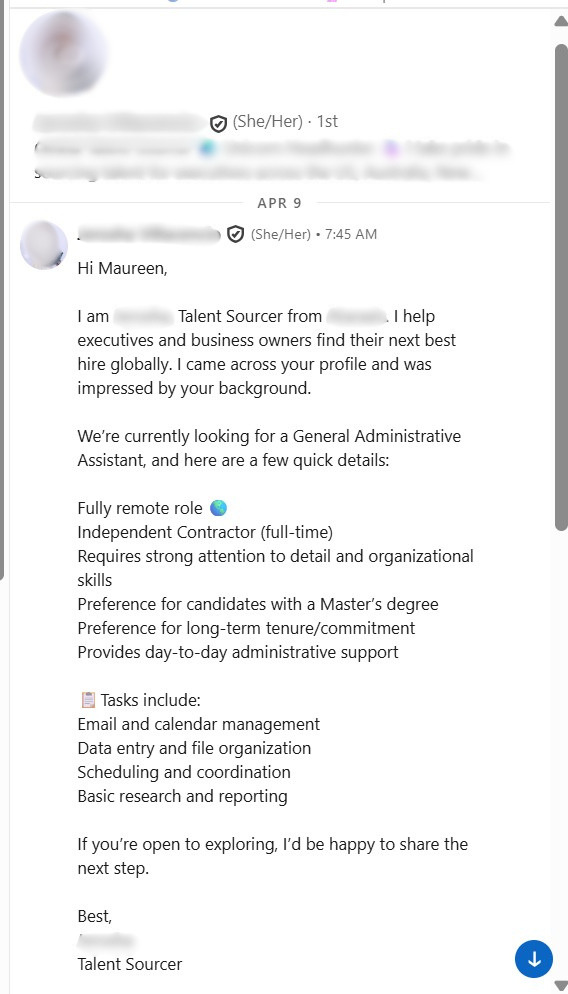
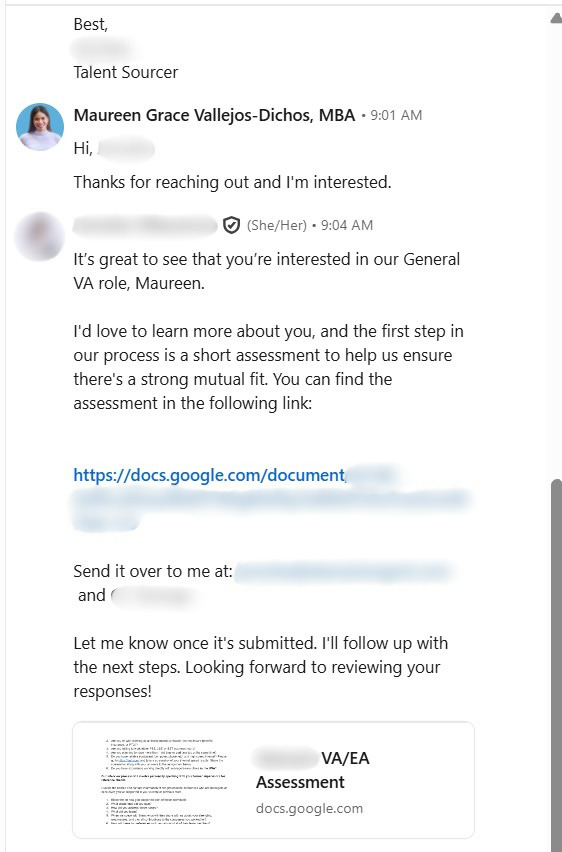
I responded to the InMail to express my interest. The reply was not a calendar invite or a short screening call, but a written assessment.
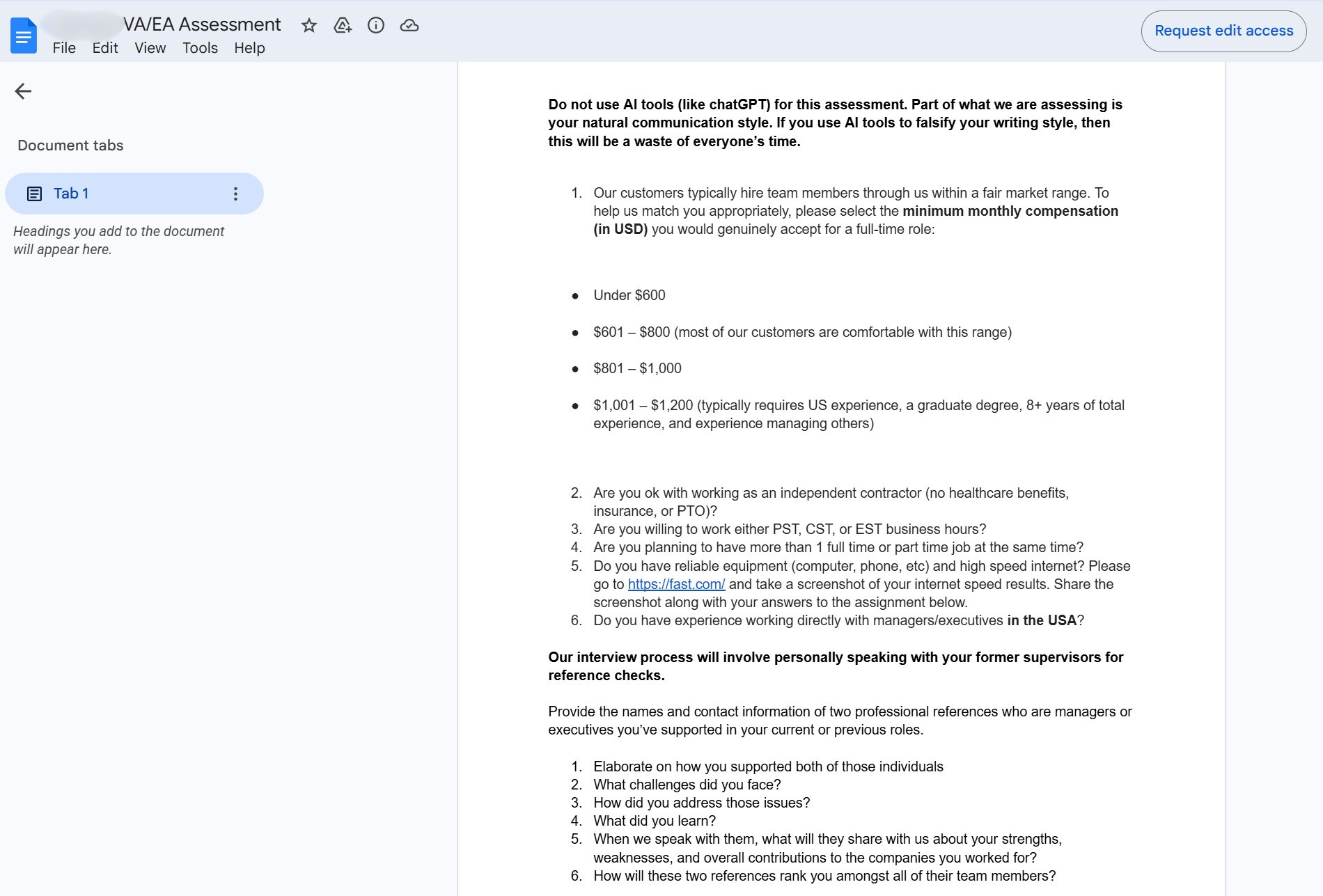
The first thing it told me was that I was not allowed to use AI tools to write any of my answers. They wanted to assess my “natural communication style.” Any attempt to use AI would be considered a waste of everyone’s time.
Fair enough, I thought. Let me see what they’re asking.
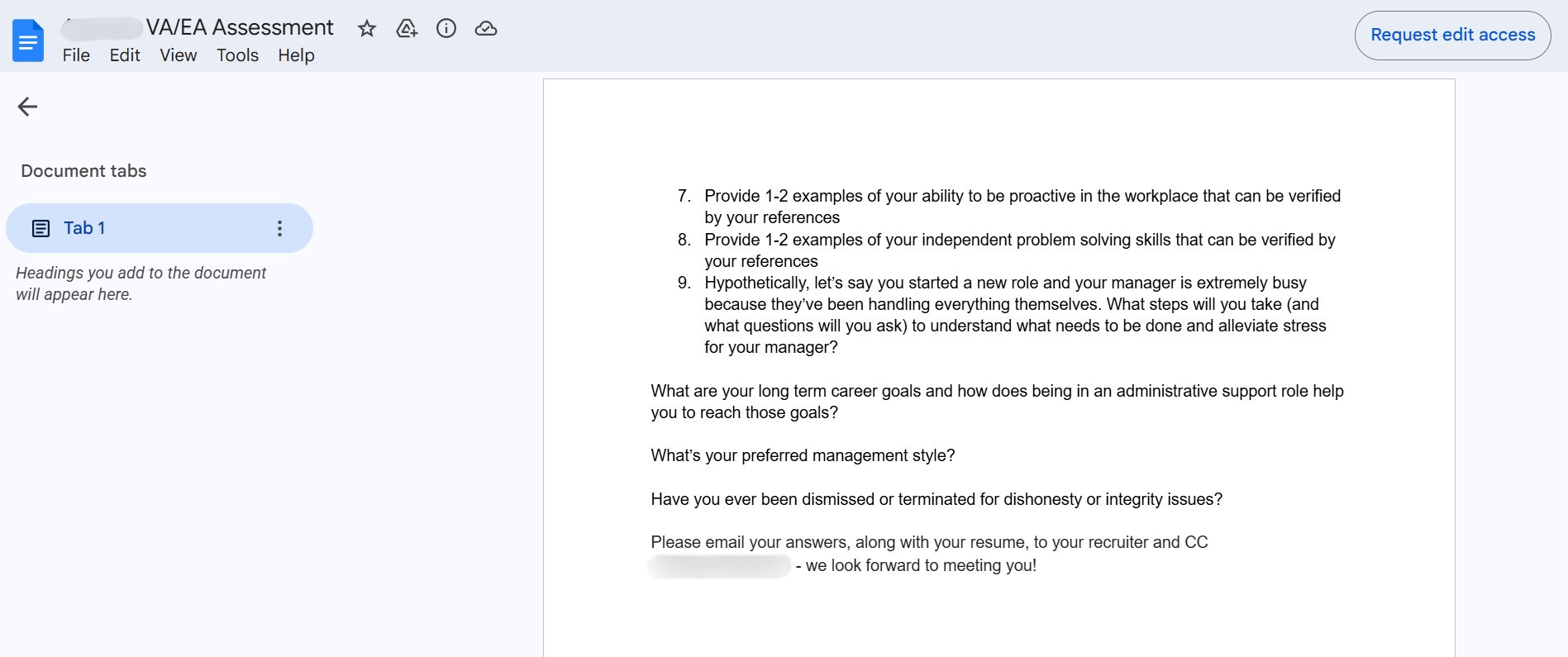
What followed was a lengthy list of requirements:
1. Compensation
The assessment opened by asking me to select the minimum monthly compensation I would accept. The options ranged from under $600 a month to a top tier of $1,001–$1,200. That top tier, the one that paid the most, came with its own set of prerequisites: U.S. experience, a graduate degree, eight or more years of total experience, and prior experience managing others. In other words, the highest pay band for a full-time, fully remote, independent contractor role, capped out at $1,200 a month, and only if you brought all four of those qualifications to the table.
2. Benefits
None. The role was independent contractor only. No healthcare, no insurance, no PTO. To be clear, being a VA is independent contractor work. That part isn’t unusual. Whether a client offers things like healthcare, insurance, or paid time off varies widely. Some clients are generous with those benefits, some aren’t. That’s a matter of client preference rather than industry standard.
What stood out to me was the no PTO part. Every VA I know, regardless of how their contract is structured, takes time off for rest, for family, for sickness, for holidays, and others. A working arrangement that explicitly rules out time off or treats it as something you should be okay going without, is a red flag. This is not because contractors are entitled to formal PTO policies the way employees are, but because no time off at all isn’t sustainable for any human being doing focused and attentive work.
3. Hours
I needed to be available during U.S. business hours (PST, CST, or EST).
4. Equipment check
They asked me about my work equipment and go to fast.com to run an internet speed test, then submit a screenshot of the results.
5. References
They wanted the names and contact information of two professional references like managers or executives I had directly supported. They were clear that they would be personally calling these references.
Then came the essay portion.
For each of the two references I provided, I was asked to write out:
- How I supported that person
- The challenges I faced while doing so
- How I addressed those challenges
- What I learned from the experience
- What those references would say about my strengths, weaknesses, and overall contributions
- How those references would rank me among all the other team members they have ever worked with
On top of that, I was asked to provide:
- One or two examples of proactivity in the workplace, verifiable by my references
- One or two examples of independent problem-solving, also verifiable by my references
- A written response to a hypothetical scenario in which a new manager is overwhelmed and I need to figure out how to alleviate their stress
- A description of my long-term career goals and how an administrative role fits into them
- A description of my preferred management style
- A disclosure of whether I had ever been dismissed or terminated for dishonesty or integrity issues
All of these were to be emailed back, along with my resume, before I had spoken to a single human being in the company.
I read it through once. Then I read it through again just to make sure I was really seeing what I thought I was seeing.
I decided not to send a response.
The Realization
Out of curiosity, I also looked up the agency before responding. They’re based in the U.S. From what I could see in their website, the master’s-degree angle was part of how they positioned themselves. They actively pitched themselves as an agency that hires VAs with graduate degrees.
Spending time in the VA space for 3 years taught me that real VA hiring is about your work. Clients want to see what you can actually do which will be showcased in your portfolio, the systems you’ve built, the inboxes you’ve managed, the tools you know, and the services you can offer. They want to hear how you think and how you’d help their business.
This assessment wasn’t doing any of that.
There was no portfolio request. No work samples. No questions about the tools I use or the kinds of clients I’ve supported. Nothing about what I could actually do for them. They’re just essays, references, an internet speed test, and a pay ceiling of $1,200 a month which is a ceiling you could only reach with a graduate degree, eight-plus years of experience, U.S. experience, and management experience.
Then, it clicked me that the master’s degree wasn’t being valued, but was being used as marketing.
“Preference for candidates with a master’s degree” is the kind of line that makes a graduate-degree holder feel seen. Yet, follow it through the actual process and it doesn’t lead to better pay, better terms, or more respect. It leads to more hoops, longer assessments, and the same capped salary. The credential was only the hook and not the value.
Also, I noticed how much unpaid work was being asked for. Writing thoughtful essay answers, coordinating references, pulling examples from your career, and articulating your management style. That’s hours of real effort and was being asked for before a single human conversation.
Because I wasn’t desperate for the role, I could differentiate it because I understand both sides of the hiring world I knew what I was looking at.
This wasn’t a hiring process built to find a VA who could actually do the work. It was a sorting machine built around credentials and unpaid effort.
That’s why I didn’t respond and decided to write in this blog post about this to share to anyone who might’ve encountered this experience. I started thinking about how different this was from how I actually became a VA.
My actual VA experience
When I landed my first U.S. client, the entire process came down to a handful of things:
- My full name
- My LinkedIn profile
- My resume
- My Wise account so they could pay me
- Zoom call
There are no essay assignments, no reference rankings, no internet speed screenshots, no graduate degree verification, and no multi-tier compensation chart with a long list of prerequisites attached to the top one.
My client and I had a real conversation. They wanted to know what I could do, what tools I was comfortable with, and how I’d approach their work. I showed them, they saw the fit, and we started.
The whole thing felt like what hiring is supposed to feel like which is about two individuals figuring out if they could work well together.
The most telling part? Nobody asked about my MBA.
It didn’t make me less hireable. It just wasn’t the point. The point was whether I could help them and I could.
What this showed me
A master’s degree, like my MBA degree, is valuable. I’m glad I have mine and I wouldn’t trade the experience of earning it for anything.
However, it’s not what made me hireable as a VA.
What clients around the world are actually paying for is different. As I mentioned previously, they’re paying for skills. They’re paying for someone who can communicate clearly, follow through on details, take initiative when something goes sideways, and understand their business well enough to actually help it grow. They’re paying for reliability and judgment.
None of that is printed on a diploma. You build it through real work and real feedback.
A degree might help you stand out in certain niches. It might give you a useful frame of reference. It might shape the way you think which in my case, I certainly did. Yet, it isn’t the qualifier.
The moment you stop treating it as the qualifier, you stop measuring yourself against credentials and start measuring yourself against the work. You stop letting agencies tell you what your value is. You start showing it instead.
The Filipino VAs I’ve come to admire
There are amazing VAs out there who don’t have a master’s degree. Many of them have skills I don’t have and the skills you can’t teach in a classroom.
I’ve watched VAs without graduate degrees earn more, not because credentials don’t matter at all, but because in this work, what you can do matters more.
The VA industry isn’t a hierarchy with degree-holders at the top. Every VA is offering a unique combination of skills, experience, and personality to the clients they serve. The right client, the kind worth working with, sees that and pays for it.
That’s why no agency should be allowed to flatten this work into a single credential checkbox. A degree is one piece of someone’s story. It’s never the whole story. It’s certainly not the measure of what someone is worth as a VA.
A word of caution about agencies like this
I know other VAs are applying to opportunities like this one. Many of them are early in their careers and are eager to land an international client. They’re unsure of what’s normal and what isn’t. They deserve to know what to look for.
To be fair, agencies usually do have more requirements than individual clients which is understandable. They’re placing candidates with multiple businesses, vetting on behalf of clients who trust them to filter well, and protecting a reputation built across many placements. A more thorough screening process makes sense in that context. I’m not saying agencies should hire the way a small business owner does.
What I am saying is that a master’s degree shouldn’t be one of those requirements.
So, here’s what I’d want every VA reading this to keep in mind.
It’s reasonable for an agency to ask for more than an individual client would. References, work samples, a proper interview, even an assessment are all fair, especially for higher-paying roles.
It’s not reasonable for an agency to use a master’s degree as a gatekeeper.
It’s not reasonable for the requirements to keep stacking with no clear endpoint, or for the compensation to stay capped no matter how much you bring to the table, or for hours of unpaid work to be expected before a single human conversation.
When you see those patterns together, trust what you’re seeing. The right opportunities, agency or otherwise, feel different. They feel like a real exchange, where what you can do is the centerpiece, not what you happened to study.
If a process feels off, it probably is and you’re allowed to walk away.
What to focus instead
If you’re a VA or someone thinking about becoming one, here’s what I’d say.
Spend less time worrying about whether your credentials are enough. Spend more time getting good at something a business actually needs.
Learn the tools your clients use. Build a portfolio that shows the work you’ve done and the systems you’ve put together. Get comfortable talking about your skills. Show up on LinkedIn. Make your resume reflect what you can actually offer, not just where you’ve been. These are a just some of the few things that you can do.
Remember that what you bring is unique to you. Your combination of skills, experience, personality, and care is something no one else has. The right clients will see that and they’ll pay for it.
A master’s degree is a wonderful thing to have. Mine has shaped me in ways I’m grateful for, but it isn’t what made me a VA. It isn’t what will make you one either.
Your skills will. Your judgment will. Your willingness to keep getting better at the work will.

Leave a Reply